
Foresight in Practice: Inhabiting Time
What if changing how we think about the future requires first changing our relationship to time? Exploring foresight practice across multiple temporal realities.

This essay is part of the Future Days 2025 Annual Report, which documents the insights, experiments, and emergent themes from this year’s gathering “Towards Symbiotic Futures.” Download full report here.
Water drips from ancient ferns in Lisbon’s Estufa Fria. I sit cross-legged on black cork furniture, sketching futures in a handmade zine while conversations unfold around me: unhurried, intertwined, alive. The sound marks time differently than any clock.
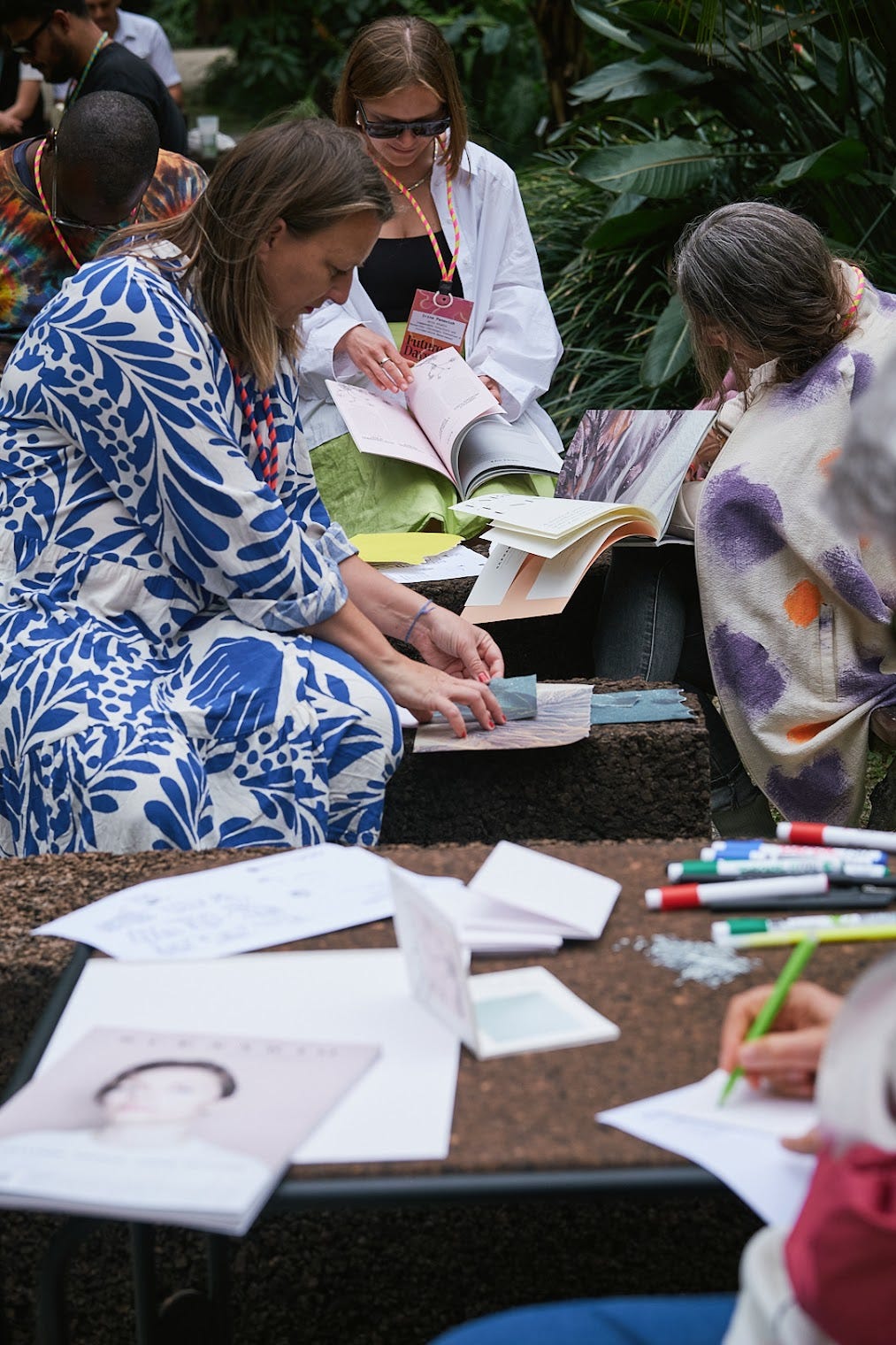
Photo by Angel Bambu
I come to this reflection carrying layered relationships with time. I work with ethical protocols that honor different ways of knowing while exploring how communities organize across time through emergent networks. These experiences have shaped what I noticed and amplified in this weaving of voices from Future Days - a lens that privileges emergence over certainty, networks over hierarchies.
I invite you to sit with the questions that emerged rather than seeking definitive answers.
In those gardens, I encountered a deeper provocation: what if changing how we think about the future requires first changing our relationship to time itself?
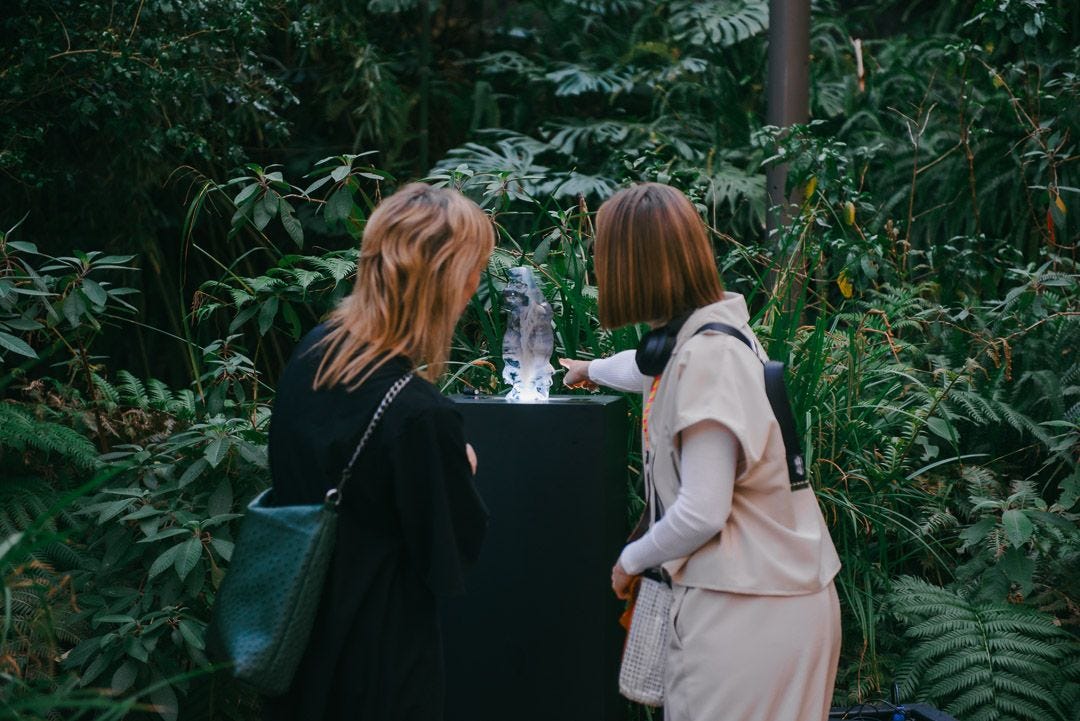
Exploring Specter[al]s of Nature with Ingrid Mayrhofer-Hufnagl. Speculative cartography that transforms satellite water data into 3D sculptures, revealing time as a dimension of ecological change. Photo by Felipe Paladini.
An invitation to contemplate
We’ve become accustomed to thinking of time as strapped to our wrists, a repetitive rhythm of the ticking clock, linear progressions, and quantitative measurements. But time is also made up of relationships, experienced as a woven fabric enmeshed with ecological and more than human processes.
At Future Days 2025, the tension between measured time and lived time in place became visible. Across keynotes, unconferences, art installations, and guided meditations in Lisbon’s botanical gardens, a different understanding of foresight practice emerged.
The gathering became an experiment in inhabiting time differently, focusing less on predicting the future and more on expanding our relationship with time.
The power of Future Days 2025 lived not only in the keynote speeches and immersive workshops, but also in its quiet intervals. The curation of space invited moments of reflection where new understanding could take root.
This article traces how the gathering revealed foresight practice expanding beyond prediction toward something more fundamental: changing our relationship with time.
Three patterns emerged:
temporal presence - staying with current complexity while cultivating imaginative capacity.
the politics of imagination - whose temporal experiences get archived directly shapes which futures become thinkable.
spatial dimensions of time - changing our relationship with time requires changing where future-thinking happens.
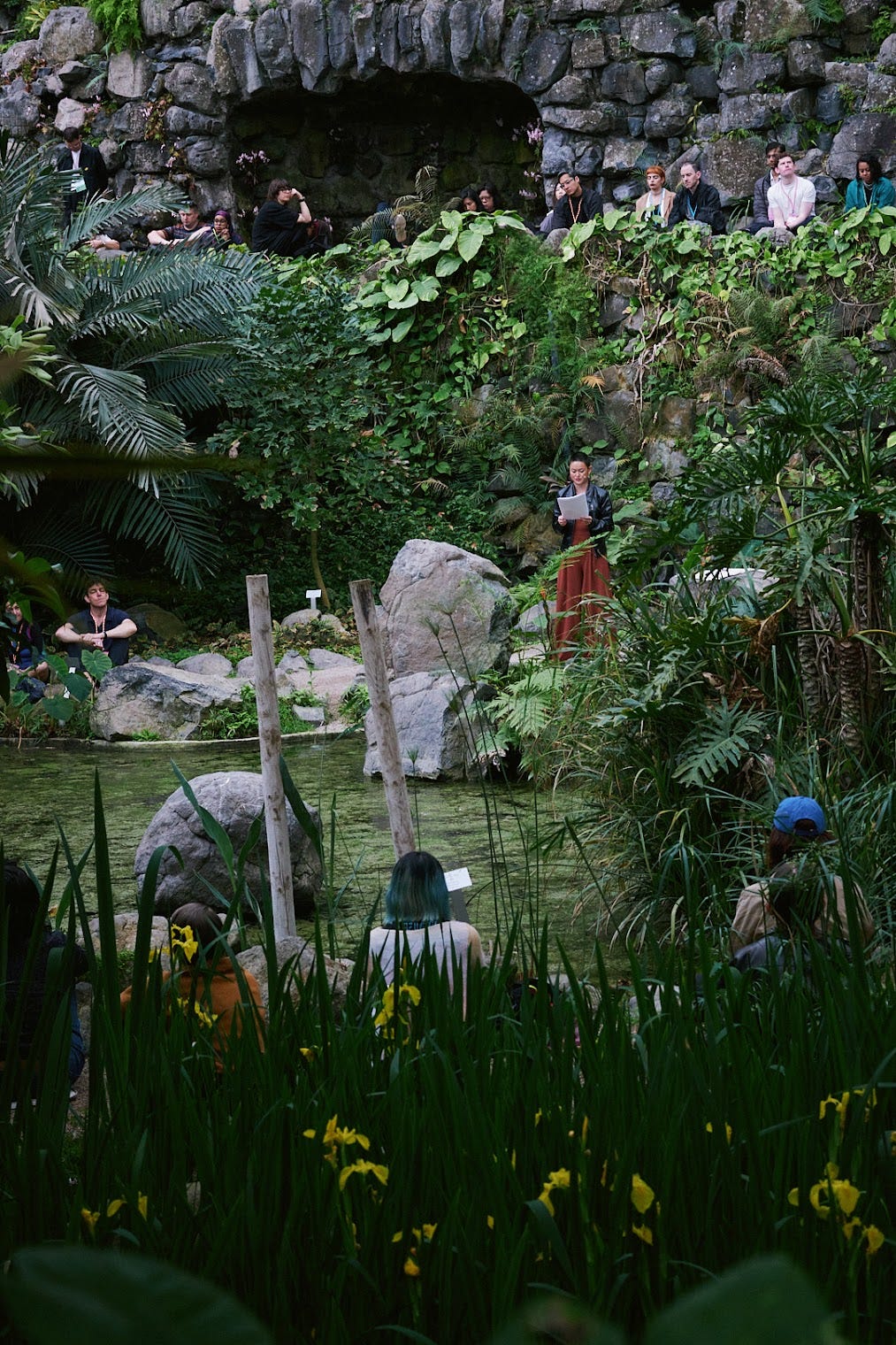
In “Sensing into Each Other”, Monika Jiang read us a love letter to Future Days while guiding us through presence, movement, and listening. Photo by Angel Bambu.
Staying with the trouble
Foresight as a discipline has been about constructing meaning from our relationship with time, extrapolating the past’s probability into the future’s possibilities.
When I think of foresight practice, trend analysis, scenario planning, and planning horizons come to mind first. They have provided necessary structure and analytical rigor - essential tools for logistics, risk management, effective disaster responses and anticipation.
Yet, in a transition where we are experiencing a re-entangling of the world and where old frameworks bring us closer to the edge of default lines, we need to either “become symbiotic or collapse” - as Sohail Inayatullah said during his keynote1, setting the stakes for everything that followed.
What if this transition requires more than refining existing parameters?
What if foresight was extended to create immersive spaces where people can feel, imagine and embody different temporalities?
What if foresight’s value wasn’t in being right about tomorrow, but in expanding our capacity to sit with uncertainty today?
At Future Days, in conversation with foresight experts and practitioners from many other disciplines - human rights activists, software engineers, policy designers, artists, technologists, economists, students - I witnessed an increasing emphasis on engaging future visions with current political realities.
During the unconference sessions, small groups clustered around tables, voices getting more animated as they spoke of the need to stay in relationship with humanity, to stay with the trouble. They emphasised the need for new language, narratives, metaphors, somatic and embodied practices to create enabling conditions for change within and outside of institutions.
In her book Staying with the Trouble: Making Kin in the Chthulucene, Donna Haraway defines staying with the trouble as being fully present, honoring the interconnectedness with the fluid “configurations of places, times, matters and meanings”2.
But staying with the trouble is harder than it sounds.
When our modern technology and rational methods for seeking answers have subdued our instinct to look beyond the ant mill of late-stage capitalism, staying with the trouble requires mindfulness and slowing down.
When we slow down, we see things differently. From this vantage point, sensing the future while holding space to understand today’s geopolitical cruelty can prompt deeper reflections on the crises that plague us. As Simon Höher points out: “We have to go further than the “double diamond”, we mustn’t narrow down to “silver bullets”3.
We have to create enabling conditions so that we have possibilities to choose.
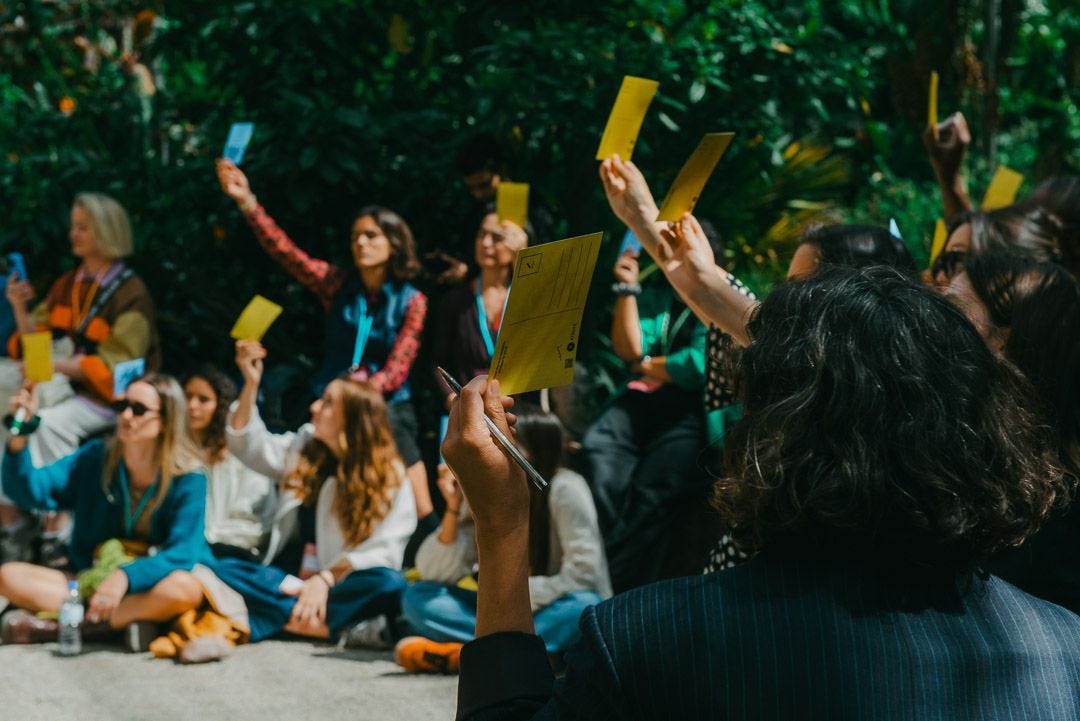
Photo by Felipe Paladini
Out of time: when archives shape imagination
We validate historical accounts by finding recurring patterns, which become accepted truth.
When did we start expecting the future to justify itself with the same certainty we demand from the past?
Why do we reduce tomorrow to the computational aesthetics of prediction models and algorithmic certainty?
Rob Hopkins reveals in How to Fall in Love with the Future4 that our brains activate identical neural networks for both memory and imagination - making memory essential to envisioning any future. This neurological reality becomes deeply problematic when predictive systems have archived only one way of being in time.
Our capacity to imagine futures depends on our stored memories. Erasing certain experiences from collective archives directly damages our ability to conceive different tomorrows.
Lex Fefegha at Future Days 2025
Lex Fefegha’s insight that “missing archives create missing futures”5 revealed how archives are more than storage systems. They’re the scaffolding for our imagination. When voices are absent from our records, we misunderstand the past and constrain which futures seem thinkable. The archive becomes a prophecy. AI systems trained on biased data project distorted futures that reinforce existing exclusions.
The Copenhagen Institute for Futures Studies’ “pasts cone”6 methodology - presented in their workshop on alternative histories - acknowledges that our foresight apparatus has been constructed from a singular way of being in time.
Rather than treating the past as a fixed foundation for extrapolation, it recognises multiple pasts: suppressed histories, alternative timelines, marginalised temporal experiences that conventional foresight renders invisible. Here, prediction’s “objectivity” reveals itself as a series of political choices about whose temporal experience counts as real.
This opens pathways to what Simon Höher calls “unthinkable futures” - possibilities that emerge when we step outside dominant temporal frameworks. Kira Xonorika’s “Deep Time Dance” film7, screened during the festival, illustrates this possibility through a Futurist-Guaraní, Two-Spirit perspective that narrates creation through the hummingbird who shaped the world.
Where Western futures thinking asks “What will happen next?”, Indigenous cosmology asks “How do we create generative conditions?”
In “Deep Time Dance”, time becomes a creative dance rather than linear progression, where past, present, and future are entangled. The foresight practitioner working from this understanding starts tending conditions by learning to hold complexity without rushing toward solutions. Such approaches generate new possibilities precisely because they refuse the tyranny of singular time.
But these temporal frameworks remain abstract until language makes them operational - the words “emergence,” “tending,” and “conditions” become tools for building worlds.
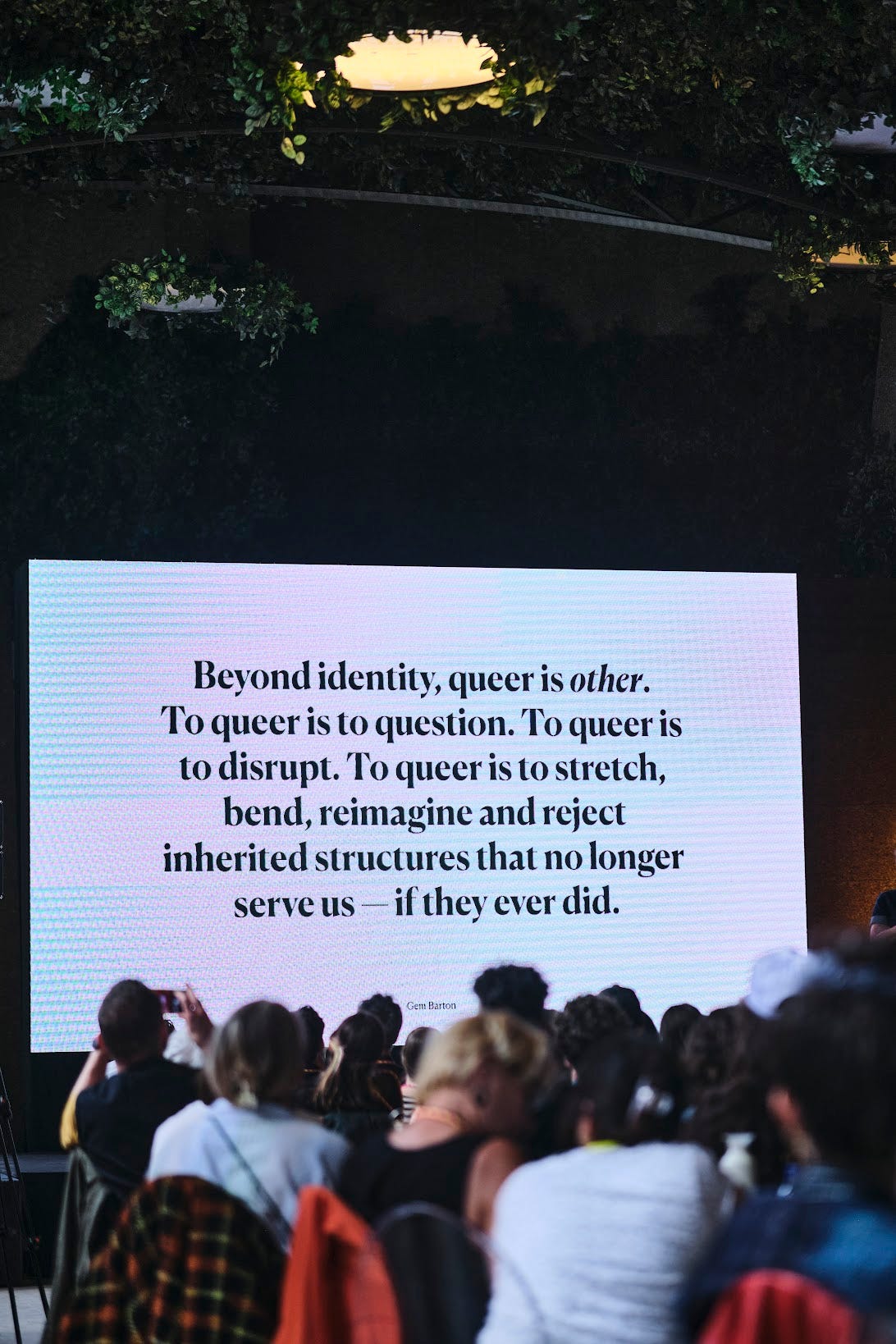
“Words build worlds” - Gem Barton in Rehearsing the Not-Yet. Photo by Ly Takai
Language creates futures. Words shape what becomes thinkable and achievable. New terms enable us to conceptualize and implement previously unthinkable solutions. This makes language a crucial instrument for gaining agency over our circumstances and expanding our sense of possibility.
In Beyond the Circle: Triangle, Stories and Socio-technical Futures8, Nanditha Krishna argues that literary thinking and fictions offer a “counterweight to a world saturated with algorithmic logic.” Through weaving new stories and exploring alternatives to dominant narratives, we can expand imagination and sharpen our ethical lens. Yet expanding imagination inevitably confronts a more uncomfortable question.
Whose tomorrow?
Whose imagination is included and whose is rendered invisible?
When Ramla Anshur (attendee at Future Days) intervened during the Dark Matter Labs un-conference, she pierced through the comfortable abstraction: “the violence many face while trying to imagine just futures...communities targeted for activism, or paralyzed by survival.”
As we cultivated “temporal presence” in Lisbon’s gardens, communities in Palestine, Congo, and Sudan were experiencing time as immediate survival. The weight of bombs. Children counting days without food or clean water. Their temporal reality, unjustly, is about enduring the present long enough to see tomorrow.
This absence was structural. The conditions enabling leisurely reflection exclude those whose temporal experience might most challenge our frameworks. Economic security. Physical safety. Visa access.
When imagination becomes labor, only those who can afford it shape which futures become thinkable.
For foresight practitioners, this raises a question that lingers: how might we work with temporal imagination while acknowledging its inherent privilege? The communities most constrained by survival temporalities often carry the most essential insights about resilience, adaptation, and alternative organizing principles. Yet these are precisely the voices missing from spaces of reflection.
I witnessed practitioners at Future Days beginning to explore this tension. Some were wondering how to redistribute the conditions that make temporal imagination possible. What would it look like to shift resources? To fund community-led research, compensate experiential knowledge, create accessible participation formats?
The practical challenge becomes: how do you design foresight processes that center survival temporalities rather than treating them as external constraints? How do we ensure expanding our temporal imagination doesn’t become another form of temporal escape?
Grounding in the moment: environment as method
We are designed to sync with the natural world. Our internal rhythms respond to environmental cues. By tuning into these cycles, we can experience time as a connection rather than constraint. Time takes on a shape in space. This understanding shaped Future Days’ curation by applying foresight practice in action:
● The ANTICIPATE and Danish Design Center zine-making session created physical artifacts as “prototypes” of future scenarios.
● PwC Japan’s “Futures Omikuji” installation allowed visitors to engage with possibilities personally - pulling paper fortunes that sparked unexpected conversations.
● The Specter[al]s of Nature9, part of the European Commission’s SciArt program NaturArchy, turned art into a policy stakeholder, moving creative work from museum walls into civic imagination around the depleting great lakes.
As Future Days curator Meri Sahade writes: “We curated this experience as a living system where space, material, people, and intention created an environment that could be inhabited.”
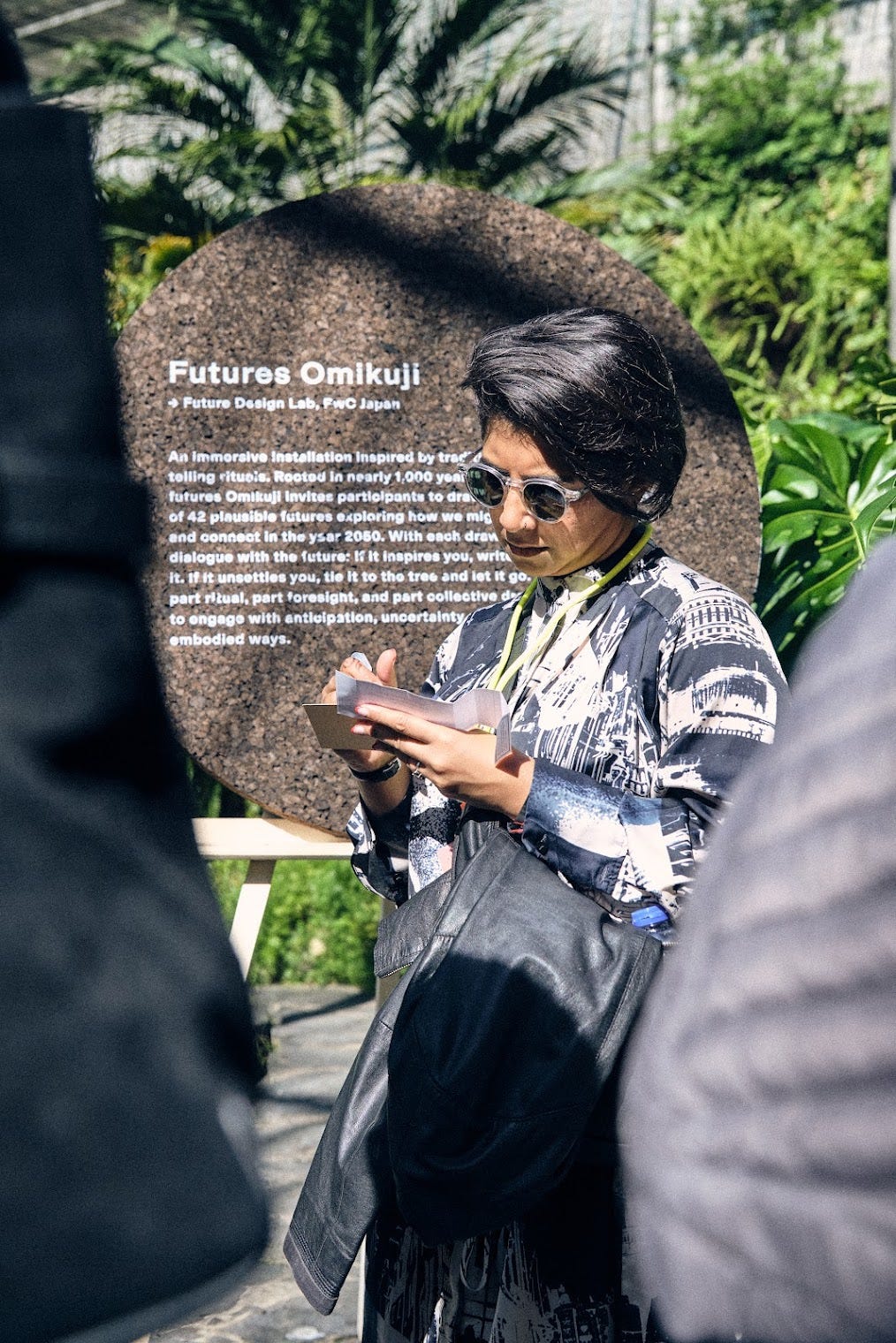
Future Design Lab, PwC Japan drew from ancient fortune-telling practices, not to predict the future, but to provoke emotional engagement with possibility. Photo by Ly Takai.
These were interfaces; ways to engage with complexity that bypass the analytical mind’s tendency to reduce everything to manageable categories.
This reflects Gem Barton’s pedagogical method from superFUTURES10, a research-led speculative spatial design unit at the Royal College of Art, rooted in queer theory, experimental realism, and her own coined concept of speculative spatial design.
Instead of training people to navigate predetermined futures, she encourages students to engage with “the layered, conflicting, co-existing” - “to sit with uncertainty without endpoints.” She’s teaching people to exist differently within time and space, transcending “practicality, which is a colonial demand rooted in the logics of Western science.”
The practitioner as a temporal guide
The patterns that emerged at Future Days suggest foresight practice might need to work with multiple approaches to time at once.
Data-driven scenario planning remains essential for institutional decision-making. But alongside these established methods, practitioners are experimenting with creating spaces where bodies feel different rhythms, where Indigenous cosmologies inform policy processes, where survival temporalities shape strategic planning.
The challenge is about expanding where thinking happens. Conventional futures work struggles to include certain ways of experiencing time. It’s not because they’re inherently unknowable, but because accessing them conflicts with foresight practice’s usual conditions.
The practitioner working from this understanding becomes skilled at moving between temporal modes. They learn when prediction serves and when presence matters more.
They discover that changing how we relate to time happens through accumulated small choices about where thinking takes place and whose temporal experiences get centered.
This is where the real practice lives - in the gaps between conference room efficiency and garden reflection, between data-driven analysis and imagination’s need to wander, inherited frameworks and the ones we’re still learning to inhabit.
The practitioner becomes skilled at creating hybrid spaces where both the clock’s urgency and time’s deeper currents can breathe together.
They discover that changing how we relate to time means changing where we think.
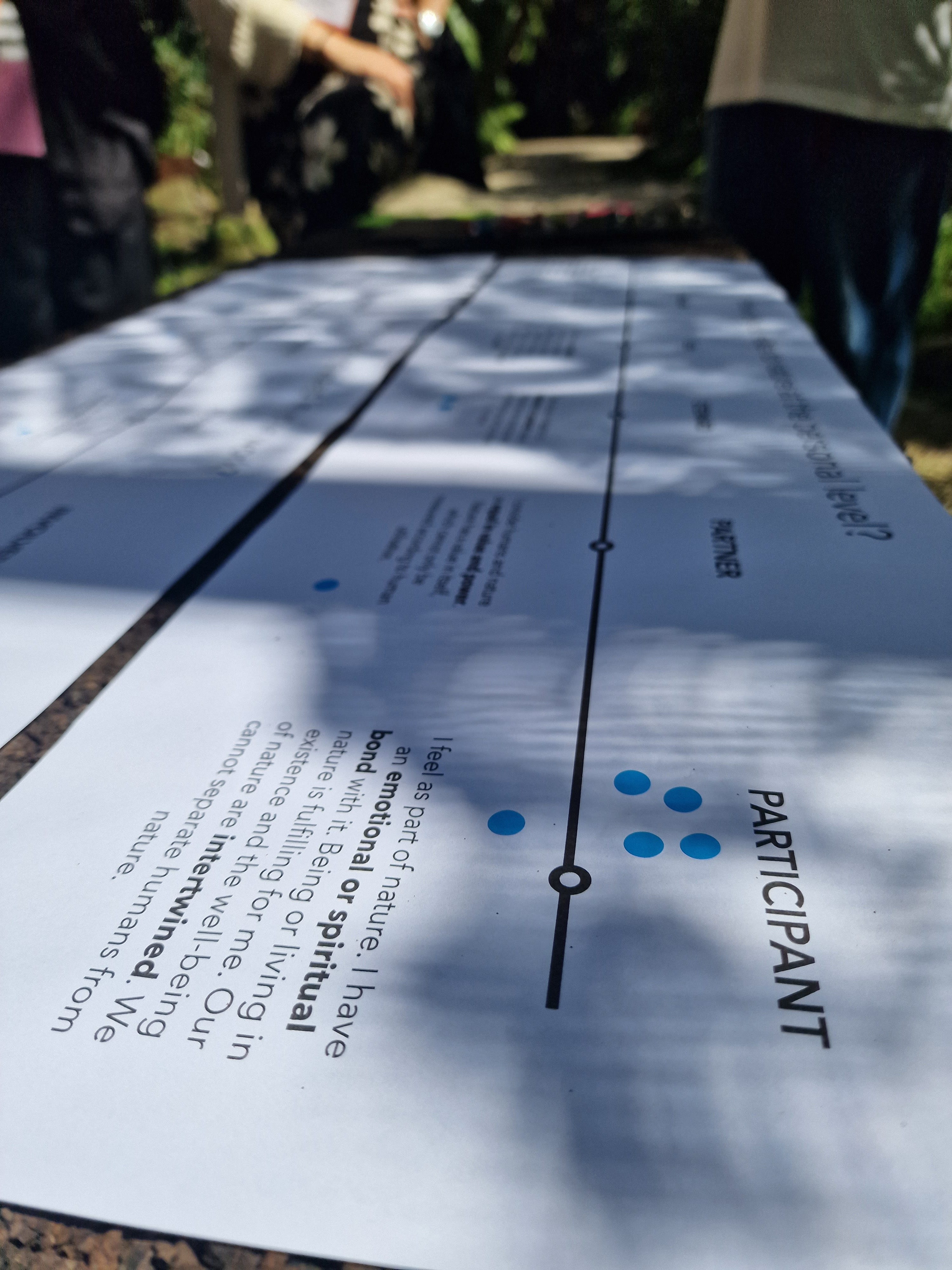
Interactive session during the Rights of Nature workshop hosted by the EU Commission.
Haraway, D. J. (2016). Staying with the Trouble: Making Kin in the Chthulucene. Duke University Press.
Hopkins, R. (2025). How to Fall in Love with the Future: A Time Traveller’s Guide to Changing the World. Chelsea Green Publishing.
CIFS. (2025). “Is this the time”. Lab at Future Days 2025.
Krishna, N. (2025). Young Future Makers Fellowship Program, Future Days 2025.
European Commission. (n.d.). Spectr[al]s of nature. Science Art Society.
Barton, G. (2025). superFUTURES, Royal College of art, London, UK